Maverick and Comet Repair
Suspension
Front End Alignment
NOTE: The procedure
for checking and adjusting front wheel alignment requires
specialized equipment and professional skills. The following
descriptions and adjustment procedures are for general reference
only.
Front wheel alignment is the position of the front wheels relative to each other and to the vehicle. It is determined, and must be maintained to provide safe, accurate steering with minimum tire wear. Many factors are involved in wheel alignment and adjustments are provided to return those that might change due to normal wear to their original value. The factors which determine wheel alignment are dependent on one another; therefore, when one of the factors is adjusted, the others must be adjusted to compensate.
Descriptions of these factors and their affects on the car are
provided below.
NOTE: Due not attempt to check and adjust
the front wheel alignment without first making a thorough inspection
of the front suspension components.
Camber
Camber angle is the number of degrees
that the centerline of the wheel is inclined from the vertical.
Camber reduces loading of the outer wheel bearing and improves the
tire contact patch while cornering.
Caster
Caster angle is the number of
degrees that a line drawn through the steering knuckle pivots is
inclined from the vertical, toward the front or rear of the car.
Caster improves directional stability and decreases susceptibility
to cross winds or road surface deviations.
Steering Axis Inclination
Steering axis
inclination is the number of degrees that a line drawn through the
steering knuckle pivots is inclined to the vertical, when viewed
from the front of the car. This, in combination with caster, is
responsible for directional stability and self-centering of the
steering. As the steering knuckle swings from lock to lock, the
spindle generates an arc, the high point being the straight-ahead
position of the wheel. Due to this arc, as the wheel turns, the
front of the car is raised. The weight of the car acts against this
lift and attempts to return the spindle to the high point of the
arc, resulting in self-centering, when the steering wheel is
released, and straight-line stability.
Toe-In
Toe-in is the difference of the
distance between the centers of the front and rear of the front
wheels. It is most commonly measured in inches, but is occasionally
referred to as an angle between the wheels. Toe-in is necessary to
compensate for the tendency of the wheels to deflect rearward while
in motion. Due to this tendency, the wheels of a vehicle, with
properly adjusted toe-in, are traveling straight forward when the
vehicle itself is traveling straight forward, resulting in
directional stability and minimum tire wear.
ADJUSTMENT PROCEDURES
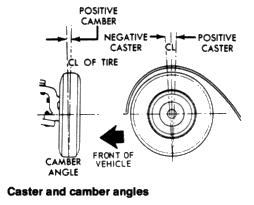
Caster
Check the
caster angle at each front wheel. The caster angle is the fore-aft
tilt of the top of the wheel spindle, as shown in the accompanying
diagram. Positive caster exists when the spindle tilts towards the
rear; negative caster is present when the spindle tilts towards the
front. The correct caster angle should be between -1-1/2° and +
1/2°. When checking, the maximum caster difference between the two
front wheels should not exceed 1°. However, if the caster is to be
set, the wheels should be set within 1/2° of each other, with both
being in the negative 1-1/2° to positive 1/2° range.
NOTE:
Because the front suspension angles are interdependent, the
preceding specifications assume that camber is also within
permissible limits.
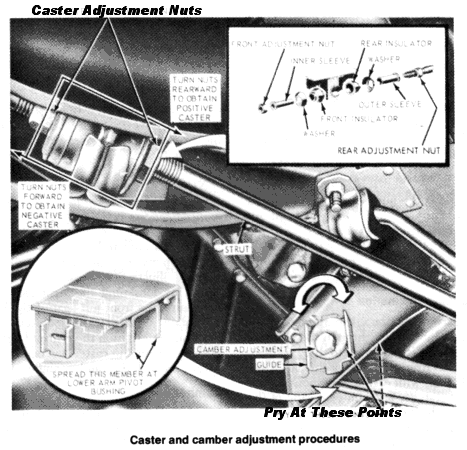
Caster is adjusted by the position of
the front suspension strut, shown in the accompanying illustration,
Positive caster is obtained by loosening the strut rear nut and
tightening the front nut against the bushing. To obtain negative
caster, loosen the strut front nut and tighten the rear nut against
the bushing. After the caster has been adjusted, always recheck the
camber angles.
Camber
Check the camber angle at each front
wheel. Camber is the angle at which the front wheels are tilted at
the top (see accompanying diagram). Positive camber exists when the
top of the wheel tilts outward; negative camber is present when the
top of the wheel tilts inward. Camber angle should be within the
range -1/2° to +1°, with the maximum camber difference between the
front wheels being 1° for checking purposes and 1/2° for setting
purposes. In other words, when setting the camber angles, the two
wheels should be within 1/2° of each other with both being in the
range of negative 1/2° to positive 1°.
The camber adjustment is controlled by the eccentric cam located at the lower arm attachment to the side rail (see accompanying illustration. To adjust the camber, loosen the camber adjustment bolt nut at the rear of the body bracket and spread the body bracket at the camber adjustment bolt area just enough to allow lateral movement of the arm when the adjusting bolt is turned. The bolt and eccentric are rotated clockwise from the high position to increase camber or counterclockwise to decrease camber.
After the caster and camber angles have been adjusted to the proper specifications, tighten the lower arm eccentric bolt nut and the strut front nut securely. Recheck the angles to be sure that they have remained within specifications.
Toe-In
Before checking and adjusting the
toe-in, remove the alignment height spacers used in the caster and
camber checks and adjustments. Toe-in should only be checked and
adjusted when the caster and camber are within specifications. The
toe-in is checked with the front wheels in the straight-ahead
position. If the car is equipped with power steering, run the engine
so that the power steering control valve will be in the center
position. Measure the distance between the extreme front points of
the front wheels, then compare this to the distance between the two
extreme rear points. The difference between the distances is the
amount of toe-in or toe-out of the front wheels. The front wheels
should be toed-in (front measurement less than rear measurement) by
1/16 in. to 5/16 in.
Adjustment of the toe-in and the steering wheel spoke position can be accomplished at the same time. When the front wheels are in the straight-ahead position, the steering wheel spokes should be horizontal. Loosen the two clamping bolts on each spindle connecting rod sleeve (see accompanying illustration). If the toe-in is incorrect and the steering wheel spokes are in the proper position, lengthen or shorten both rods equally until the correct toe-in is obtained. If the toe-in is incorrect and the steering wheel position is also incorrect, adjust the rods as necessary to obtain correct toe-in and steering wheel alignment. Check the toe-in and steering wheel position again. If the toe-in is correct, but the steering wheel position is incorrect, turn both connecting rod sleeves upward or downward the same number of turns in order to move the steering wheel to the proper position. When both the toe-in and the steering wheel position are correct, lubricate the clamps, bolts and nuts and tighten the clamping bolts on both sleeves to a torque of 9-15 ft. lbs. Be sure that the sleeve position is not changed when the clamping bolts are tightened. Recheck the toe-in and steering wheel position.